One of the best things I discovered in the Vatican Museums is the ceiling of the chapel in the house of Saint Pius V
(1566-1572). Painted by blog favourite Giorgio Vasari
and Federico Zucarri, this dome depicts a raging battle between angels and demons, heaven and hell.
The no holds barred brutality of these pairs struck me right away. The angels rip the hair of their opponents while stamping on their groins, bearing down upon them from above. For all their fluttering wings and soft pastel hues, these are muscular warriors mercilessly dominating lesser beings. Each is poised seconds before delivering the killing blow. For their part, the demons are frozen in their last desperate moments, alternately struggling and giving way; their part human, part animal bodies no match for the glorious power of the angelic army.
Perhaps unsurprisingly, it is the demons who attract my greater
interest here. But I like to think it isn't just me,
and that these figures invite some empathy and
connection with viewers. Their struggle and painful fall seems, to me at least, in many ways more 'human' than the righteous violence of the angels.
Blasphemy. I know.
Anyway, without further ado, here they are.
[Obviously these pics don't do justice to the brilliant colours of the real painting, but you get the idea.]
And my favourite:
This painting really stuck with me, partly because it feels so contemporary. Ideas of good and evil - who deserves to kill versus who deserves to be killed, who is more or less human - are as charged today as they were in the sixteenth century. More so, now that we possess the technologies to annihilate each other en masse.
This continuing relevance was brought home to me two days ago when, all tangled up in a ladies fitting room, I first heard this song.
The lyrics are just perfect. It's as though she wrote them looking up at the dome.
Holy water cannot help you now
A thousand armies couldn't keep me out
I don't want your money
I don't want your crown
See I've come to burn
Your kingdom down
Holy water cannot help you now
See I've come to burn your kingdom down
And no rivers and no lakes, can put the fire out
I'm gonna raise the stakes; I'm gonna smoke you out
Seven devils all around you
Seven devils in my house
See they were there when I woke up this morning
I'll be dead before the day is done
Seven devils all around you
Seven devils in your house
See I was dead when I woke up this morning,
And I'll be dead before the day is done
Before the day is done
And now all your love will be exorcised
And we will find your sayings to be paradox
And it's an even sum
It's a melody
It's a battle cry
It's a symphony
Seven devils all around you
Seven devils in my house
See, they were there when I woke up this morning
And I'll be dead before the day is done
Seven devils all around you
Seven devils in your house
See I was dead when I woke up this morning,
And I'll be dead before the day is done
Before the day is done
Before the day is done
Before the day is done
They can keep me alive
'Til I tear the walls
'Til I slave your hearts
And they take your souls
And what have we done?
Can it be undone?
In the evil's heart
In the evil's soul
Seven devils all around you
Seven devils in your house
See I was dead when I woke up this morning
I'll be dead before the day is done
Before the day is done
I think Florence + The Machine sound how Renaissance paintings look,
if that makes sense. To use an exhausted term: they are epic.
Very similar themes at work, also.
I recommend more viewing/listening on ye olde YouTube.
I'm very interested in artists who use the word 'grotesque' and explicitly describe their work in terms of grotesqueness, because it often highlights the wide range of meanings that are associated with this term.
Musician and artist Marilyn Manson, aka Brian Warner, is one such person. Not only did he name his fifth albumThe Golden Age of Grotesque, but he also wrote a song of the same name.
Unfortunately Grotesque wasn't released as a single so there is no official music video. However, there is a video for mOBSCENE, another song from the album, which perhaps gives a clue as to Manson's definition of grotesque.
Manson went on a 'Grotesk Burlesk' tour to promote the album. If you are wondering what constitutes a grotesque burlesque, here is one version:
Manson has commented that "the deformed scar of one man, is "love's pretty dimple" to me." This preoccupation with deformation and injury - both physical and emotional - is visible in his watercolour paintings, which are deeply personal in nature.
While I may not be comfortable with all the imagery Manson makes use of, I rather doubt comfort is the response he is trying to evoke. It is difficult to deny the talent that fuels his musical and artistic work, or the complexity of the issues he wrestles with. The fact that this takes place somewhere under the banner of 'grotesque' is very interesting.
It stars Rick Genest, aka Zombie Boy, a freak show performer who recently found fame in a Lady Gaga music video. [<--- Warning, that Gaga video may put you off giving birth. Ever.]
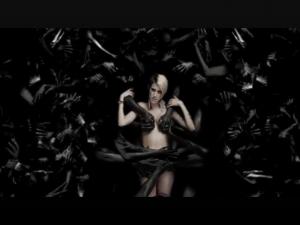
Hello strangers. I've been obsessing over this music video for a while now, and thought it worth mentioning here.
(Warning: NSFW)
There are just so many things going on.
The video has an arresting Twin Peaks vibe, with the menacing father figure, the forest and the childlike-but-not-really young woman. The gestures towards Little Red Riding Hood and Hansel and Gretel really build the sense of threatened innocence, while also shifting the scenario further into the realms of the surreal and fantastic.
For me the switching of the young woman with other, older figures evokes Mikhail Bakhtin's "hags" - the most well known example of his concept of the female grotesque:
"In the famous Kerch terracotta collection we find figurines of senile pregnant hags. Moreover, the old hags are laughing. This is a typical and very strongly expressed grotesque. It is ambivalent. It is pregnant death, a death that gives birth. There is nothing completed, nothing calm and stable in the bodies of these old hags. They combine a senile, decaying and deformed flesh with the flesh of new life, conceived but as yet unformed. Life is shown in its two-fold contradictory process; it is the epitome of incompleteness. And such is precisely the grotesque concept of the body" (Rabelais and His World. Trans. Helene Iswolsky. Indiana University Press, 1984, pp.25-6).
The passage doesn't entirely suit the video, but those manic faces (and the dead/living girl) keep reminding me of his argument here. Whatever you think of Bakhtin and his opinions, he knows how to generate a strong image.
All that said, it stupidly took me a few more views to realise why this video grabbed me so firmly. The more I watch, the more it reminds me of one of my favourite thrillers: Don't Look Now (1973). There are some very explicit references to the film in the music video, explicit enough for me to think it is a deliberate homage.
If you haven't seen it, and you enjoy Gothic mysteries and Donald Sutherland, I highly recommend this film. (Yes, there is a famously graphic love scene that pops up - so to speak - in the middle of the story, but we can fast-forward that, can't we? Or not, I'm not judging you.)
The trailer isn't super great, but at least it doesn't give the whole thing away like most do these days. (If you are interested in watching Don't Look Now, I would suggest NOT reading reviews/comments or Googling it - once spoiled can never be unspoiled!)
Finally, the scene with the grasping hands reminded me of a much more recent video; one with rather different, yet equally Gothic, connotations. In Dev's 'In the Dark' the red hands, with their suggestions of sexuality and violence, are replaced by black hands:
Some eerie imagery in this one. The play on exoticism, monstrosity, blackness and whiteness is all a bit unsettling, especially when the white singer is walking through a sea of raised black hands (claws/paws?).
Interesting. Disturbing. I guess that's what they were going for?
Another entry in my spectacularly random historical survey of grotesque writings. This time under the cloudy microscope: John Addington Symonds and his essay "Caricature, the Fantastic, the Grotesque" from Essays Speculative and Suggestive, published 1907. I think my page numbers are from this edition.
Without further ado...
In part I, Symonds begins by discussing caricature, which he defines as:
"a distinct species of characterisation, in which the salient features of a person or an object have been emphasised with the view of rendering them ridiculous" (155).
Tangent alert: the overemphasis of physical features and personal attributes isn't always utilised as an attack. Someone can deliberately caricature themselves to generate self-deprecating comedy, and/or make a point about how they are perceived.
Eg. Ludacris.
In this music video Ludacris uses caricature to highlight the ridiculous elements of his hyper-masculine public image (threatening to fight shoes), while linking his anger at overly familiar strangers with the classic "Hulk Smash!"explosions of The Incredible Hulk. The body parts emphasised here also accord with popular 'Hulk Hands' merchandising, perhaps making a commentary on the commercialisation of the male body and the perpetuation of ideas/images of male (specifically non-white/"green" male) rage and violence in society.
Also reminds me of SpongeBob SquarePants' Anchor Arms. "Now I'm a jerk and everybody loves me!"
Anyway, back on topic.
Part II sees a discussion of the fantastic, which Symonds defines as that which "invariably implies a certain exaggeration or distortion of nature," however "lacks that deliberate intention to disparage which lies at the root of caricature" (156). The author explicitly links this definition with the early grotesque style in art, arguing that the fantastical:
"may be merely graceful, as is the case with arabesques devised by old Italian painters - frescoed patterns upon walls and ceilings, in which tendrils of the vine, acanthus foliage, parts of beasts and men and birds and fabulous creatures are brought into quasi-organic fusion with candelabra, goblets, lyres and other familiar objects of utility" (156-7).
This is one of my favourite descriptions of the early grotesque.
More widely, the term 'fantastic' can be attributed to those "beautiful and terrific forms" whose creation reflects flights of fancy: "some vision of the excited imagination" (157). These include mythological creatures such as sphinxes, satyrs, dragons, fairies, spirits and so forth, in addition to tales of human/non-human metamorphosis. This is pure fabrication; the human mind making free with pieces of reality to construct something entirely imaginary. The allure of these images results in many people desiring/believing that they actually exist.
In part III the grotesque makes its appearance. "The grotesque," Symonds argues, "is a branch of the fantastic" (158).
"Its specific difference lies in the fact that an element of caricature, whether deliberately intended or imported by the craftsman's spontaneity of humour, forms an ingredient of the thing produced" (158).
This is a dubious distinction, to my mind. He has already stated that the difference between caricature and the fantastic lies in the presence or absence of a "deliberate intention to disparage." Once disparagement creeps into the fantastic it becomes caricature. So caricature = grotesque? I'm confused.
Symonds lists a variety of historical creatures and stories which he does not consider to be grotesque, because "they lack the touch of conscious caricature added to free fancy which differentiates the species" (159).
At this point, I'm still confused.
Part IV introduces the idea of obscenity as a possible clarification point.
"Closely allied to caricature and the grotesque we find obscenity... The reason is not far to seek. Nothing exposes human beings to more contemptuous derision that the accentuation in their persons of that which self-respect induces them to hide. Indecency is therefore a powerful resource for satirical caricaturists."
"It appeals to the gross natural man, upon whose sense of humour the creator of grotesque imagery wishes to work, and with whom he is in cordial sympathy" (160).
Gross indeed.
Culture determines what is acceptable in polite conversation and representation, and what is obscene. Certain facts of life (remembering this was written in 1907: sex, genitalia, faeces, menstruation, childbirth, etc.) must be experienced but not spoken of. Such obscenity, when represented:
"brings before the sense in figure what is already powerful enough in fact. It stirs in us what education tends to curb, and exposes what human culture teaches us to withdraw from observation" (162).
[Via Gerard van Honthorst (1592-1656). Smiling Girl, a Courtesan, Holding an Obscene Image.]
But where to draw the line? Individuals, even though they may share a common cultural context, differ in their opinion of what is obscene and what isn't. This point is typical for any and all discussions involving the grotesque - who says what is grotesque and what isn't? Subjectivity and cultural relativism complicate everything.
Symonds believes that certain artists have the ability to "elevate" their chosen subjects, despite their base origins.
"All depends on taste, on method of treatment, on the tone communicated, on the mood in which matters of delicacy have been viewed" (167-8).
He concludes in Part V with a discussion of the true purpose of poetry and art, advocating a middle ground approach:
"the final object of the whole concert is to delight and stimulate the mind, not to exercise the brain by logical propositions, nor to excite the appetite by indecent imagery. Precisely in this attunement of all the senses to the service of impassioned thought lies the secret of the noblest art" (165).
While this is certainly not the most convincing treatment of the grotesque I have read, it is interesting to note how it registers the difficulty in separating 'grotesque' from other terms and ideas. It also firmly severs the early grotesque from the contemporary, which many discussions do not do. Symonds claims that early grotesque art is emblematic of the fantastical, whereas 'the grotesque' is something quite different - closer to the obscene than the fanciful.
His grotesque lies somewhere at the point where caricature and the fantastic meet; generating a "peculiar connection which is necessary to grotesqueness" (159).
I'm still a bit confused. But that is hardly unusual.
Music videos are under-appreciated and under-analysed in the academic context, I think.
I like the Alien-esque body morphing and antisocial clone action in this video for Aphex Twin by visual artist Chris Cunningham.
(Although 'like' probably isn't the right word. As Miss Cakehead says, if this video doesn't frighten you: "seek help!")
Cunningham was also behind this award winning video for Bjork. Much more gentle, this one.
He made a short film called Rubber Johnny, which, as one YouTube user commented, "would give David Lynch diarrhea." It is quite disturbing. I won't be posting it, but feel free to go check the video out here. Leave the light on.
Plenty of grotesquerie to examine in relation to Cunningham's work. I'm not comfortable with much of it, but that's usually a sign that something interesting is going on.
but you can have this musical rendition of Conan's life cycle.
Nice.
Also, I will eventually post pictures of my Supanova loot. The light in my grotto/office (where I spend every waking moment) is really bad in winter so the first lot turned out dodgy. I will have another go. Maybe go outside... *skin bursts into flames*... or not.
about the issues. It's past the halfway point now; the pressure is on to do everything you said you'd do this week before tomorrow, which officially becomes 'the weekend' at 3pm.
the middle of the week, obviously. Also a day for miracles, as I'm on tender-hooks regarding a writing related development from yesterday. Just waiting to hear now. Fingers and toes still crossed.
Yes I realise this blog has abruptly turned into some kind of low budget interpretive dance studio. *sigh*
I promise to post something really grotesque soon.