Showing posts with label hybrid bodies. Show all posts

Friday, December 28, 2012

Painting The Roses Red


At first glance, inner city Perth is not the most inviting or aesthetically pleasing location in the world; especially in summer, when it goes above 40°C in the shade and burning heat radiates off every surface.


Along the train line is often the worst, with all the wires and power poles and cement everywhere. Yet this is also where some of my favourite street art lives.

This huge mural, for instance, faces the tracks and can be seen through the left-hand windows of the train as you head into the city.


I've loved this since I was a child - but this was actually the first time I've gone to have a proper close look. (Click to enlarge.)


In many ways it reminds me of the angels and demons depicted in the Vatican Museums.


(See more pics here)

The use of colour is similar, although the angel figure is dark skinned in the mural.


The combatants are also on an equal footing. Neither is above the other, neither has the strategic (or moral?) advantage.

The contrast between cave paintings on the demonic side and a more classical art style on the angelic side suggests a battle between the 'primitive' and the 'civilised.' Yet both ride vampiric steeds, and both have their faces obscured. So interesting.

Of course, this painting is not housed in a controlled space. It isn't surrounded by guards and security cameras. It is exposed to the weather, and there are no opening hours. People can come along and do whatever they like to it at any time.


Despite the odd contribution from the public, the painting has remained bright and relatively unmolested, given the location.


So good. If anyone ever tries to paint over it (as happened to another of my favourites recently. Why replace an awesome image with a blank wall? Ever?) I will be getting a little bit shirty.

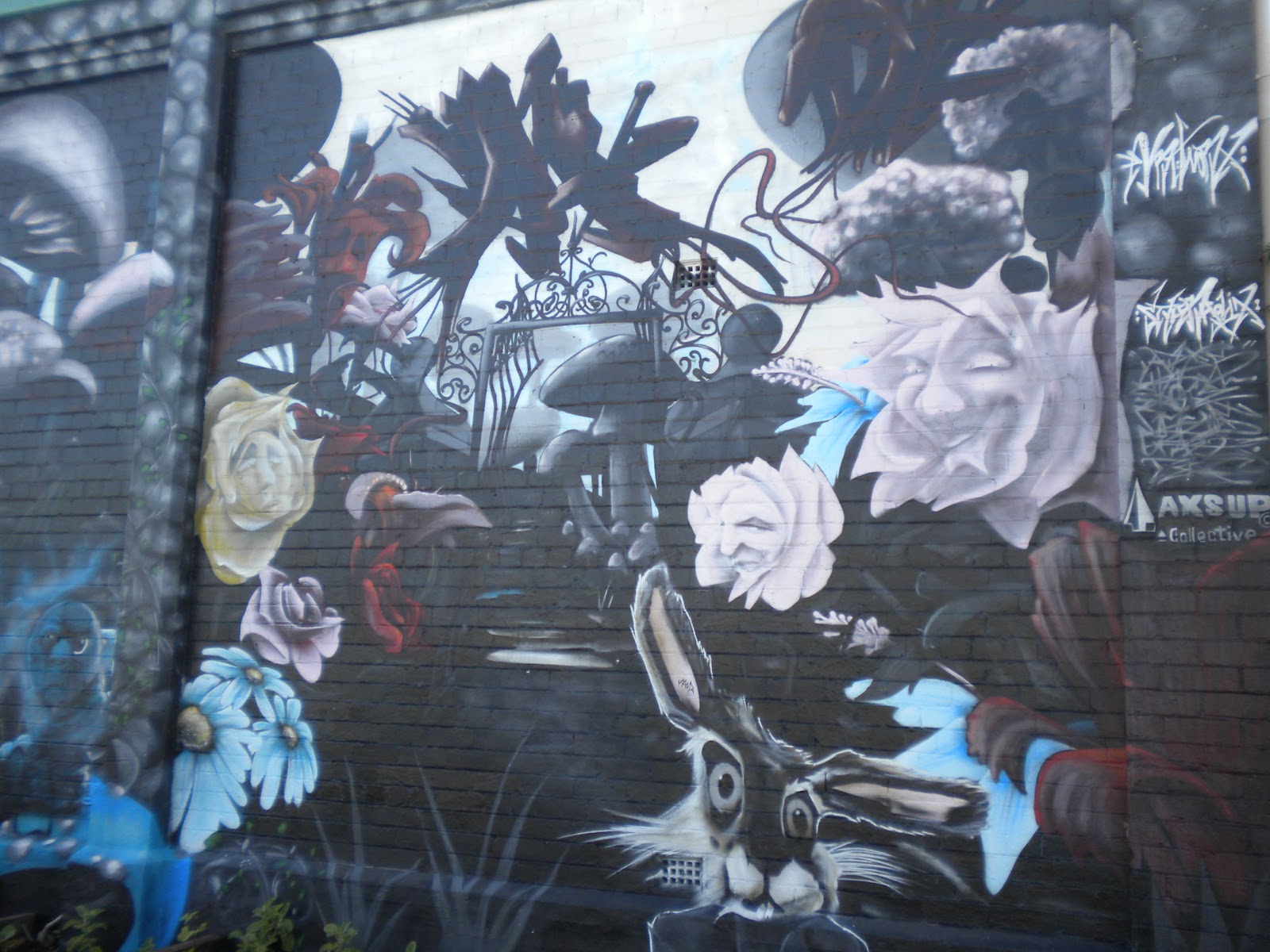
There is quite a lot of brilliant street art near the tracks in this area, including this amazing Alice in Wonderland themed mural, which runs along the outer wall of the Perth City Farm


I love the way this painting merges the urban with the fantastical - incorporating graffiti style script into the landscape.


Uh-oh. I think the Tweedles have been out tagging.


Maybe not a good idea to have a bunny guarding the seedlings!


But wait - there's more...


These remind me of the Wormouths in Commander Keen:


Nice work, DeeJo.

And last but not least, in a nearby car-park:.


Brilliant.

People pass these paintings all day without even looking, like they're nothing special. (Although they do start paying attention once someone starts taking photos - funny that, how the camera bestows 'value' on its lowly subjects...)

If anyone has names for/links to more of the artists, please let me know and I'll add them.

P.S. Happy New Year - thanks for visiting, I appreciate ya.

Monday, December 3, 2012

A Cunning Array Of Stunts

[Via]

My last post about gargoyles reminded me of Raoul Servais' Harpya (1979).

In this short film, a man falls in love with a bird-woman and takes her home with him, only to become a victim of her ravenous appetite. It's both hilarious and super creepy.


Just take those squidgy shoes off, man. Seriously.

Watching this again made me think about how many grotesque frescoes involve women with wings. When you look, they all do.


As the figure below illustrates in extremis, female grotesque bodies are often reduced to three key features - head, breasts, and wings.


These are not harpies in the traditional sense, though.

Harpies have their origins in Greek mythology. As E. M. Berens explains in A Hand-book of Mythology (1894):

The Harpies, who, like the Furies, were employed by the gods as instruments for the punishment of the guilty, were three female divinities, daughters of Thaumas and Electra, called Aello, Ocypete, and Celæno.

They were represented with the head of a fair-haired maiden and the body of a vulture, and were perpetually devoured by the pangs of insatiable hunger, which caused them to torment their victims by robbing them of their food; this they either devoured with great gluttony, or defiled in such a manner as to render it unfit to be eaten.

Their wonderfully rapid flight far surpassed that of birds, or even of the winds themselves. If any mortal suddenly and unaccountably disappeared, the Harpies were believed to have carried him off. Thus they were supposed to have borne away the daughters of King Pandareos to act as servants to the Erinyes.

The Harpies would appear to be personifications of sudden tempests, which, with ruthless violence, sweep over whole districts, carrying off or injuring all before them.

[Via]

Most contemporary representations of the harpy follow this early model, depicting the winged woman as a dangerous, hungry force of nature.


Some are scarier than others...

'Harpy' has also become a more general term for women who behave in an unacceptable manner towards men, who take too much and give too little, who 'harp on' about things.

As the Urban Dictionary's most popular definition puts it, a harpy is:
A word to describe a women [sic] who draws a man into her grasp by pleasing the victims biggest desire only to destroy all that makes him what he is.
Also:
A woman with an unbearable, shrewish, pain in the ass nature. In other words, a bitch or a harridan, especially a somewhat unappealing one.

Hmm.
[Via]

In her book The Female Grotesque, Mary Russo suggests that women who fly offer a model of deviance that constitutes a potentially transgressive "grotesque" performance. She is particularly interested in female circus performers, acrobats and pilots, whose activities transcend the imagined limits of the female body and mind.

[Stephanie Smith, human cannonball (2005). Via]

Russo wonders if "instances of aerial leaps and falls may suggest an alternative to the notion of liberation as upward mobility and flight forward," while simultaneously warning that "they end badly" (30). The woman who performs daring stunts, who throws herself off the edges of things and defies gravity, will often crash back down to earth.

I like the idea that stunts and falling are a function of agency, rather than a sign of its failure. As Russo points out, "freedom is often uncritically conceived as limitless space, transcendence, newness, individualism, and upward mobility of various kinds" (50). In contrast, falling involves "a reversal of the usual metaphors." It is downward mobility - a rough, even deadly encounter with limits and universals. Yet it results from attempts to go beyond safe zones, to risk unsanctioned moves and try new shapes. I fancy it is this spirit that infects the winged grotesques, with their ridiculous and impossible bodies.

Perhaps not such a bad thing, then, to be a harpy.

Although eating someone's parrot is going too far. Don't do it, ladies.