
Paris is wonderful. There are so many beautiful buildings, shops, museums, gardens and people to admire. But I really went to see the non-pretty things: the monsters. Specifically, the gargoyles of Notre-Dame de Paris.


Bishop Maurice de Sully conceived and supervised the initial stages of construction in the 12th century. Since then, the cathedral has born witness to many pivotal events, including the 1558 marriage of Mary, Queen of Scots, the French Revolution, and the canonising of Joan of Arc. Not to mention a bunch of man-eating wolves had their last stand there.
Even disregarding such history, the intricate detail and sheer Gothic splendour of this iconic building make it worth the trip.


Architects Jean-Baptiste-Antoine Lassus and Eugène Viollet-le-Duc (mainly the latter, apparently) got a bit over-excited during the reconstruction and ended up covering the exterior gallery with monsters. Bit cheeky, considering these additions were not included in the proposal that won them the job.


(Tangent alert) I've always assumed that Victor Hugo's The Hunchback of Notre Dame was inspired by the gargoyles we see today. Not so. The renovations began in the 1840s, while his book was published in 1831. In this, Hugo's work seems to support Viollet-le-Duc's claim that such beasts were present on the cathedral prior to restoration.
In any case, my visit reminded me of Quasimodo the bell ringer, who is presented as a living gargoyle in the novel:
The presence of this extraordinary being caused, as it were, a breath of life to circulate throughout the entire cathedral. It seemed as though there escaped from him, at least according to the growing superstitions of the crowd, a mysterious emanation which animated all the stones of Notre-Dame, and made the deep bowels of the ancient church to palpitate [...] And the cathedral did indeed seem a docile and obedient creature beneath his hand; it waited on his will to raise its great voice; it was possessed and filled with Quasimodo, as with a familiar spirit. One would have said that he made the immense edifice breathe. He was everywhere about it; in fact, he multiplied himself on all points of the structure. Now one perceived with affright at the very top of one of the towers, a fantastic dwarf climbing, writhing, crawling on all fours, descending outside above the abyss, leaping from projection to projection, and going to ransack the belly of some sculptured gorgon; it was Quasimodo dislodging the crows. Again, in some obscure corner of the church one came in contact with a sort of living chimera, crouching and scowling; it was Quasimodo engaged in thought. (Via).

[Quasimodo by Antoine Wiertz. Via]
Quasimodo has always been really interesting to me. He is often described as "grotesque"; indeed, the Encyclopedia Britannica defines him as "a classic symbol of a courageous heart beneath a grotesque exterior."
The novel is preoccupied with exteriors, human and nonhuman, and their relationships with interiors. Quasimodo is rejected for his deformities, so he becomes what others expect him to be:
"From his very first steps among men, he had felt himself, later on he had seen himself, spewed out, blasted, rejected. Human words were, for him, always a raillery or a malediction. As he grew up, he had found nothing but hatred around him. He had caught the general malevolence. He had picked up the weapon with which he had been wounded" (Via).
Even Claude Frollo, the man who adopts and raises him, sees Quasimodo as subhuman.
[...] the poor little creature was incomplete, and hardly sketched out. In fact, Quasimodo, blind, hunchbacked, knock-kneed, was only an "almost" (Via).
Accordingly, the hunchback has only the bells of Notre Dame for company. Getting into the spirit, I visited le bourdon - the great bell - when I climbed the tower.

The doors to get inside are super tiny. I like that there are no warning signs for taller people. The French expect you to take care of yourself.


Massive.
Anyway, some of the saddest passages in The Hunchback of Notre Dame involve Quasimodo's conclusion that "'Tis only necessary to be handsome on the outside." Despite his devotion, foxy love-interest Esmeralda cannot look past the 'grotesque' exterior, prompting this outburst:
"Look not at the face, young girl, look at the heart. The heart of a handsome young man is often deformed. There are hearts in which love does not keep. Young girl, the pine is not beautiful; it is not beautiful like the poplar, but it keeps its foliage in winter. Alas! What is the use of saying that? That which is not beautiful has no right to exist; beauty loves only beauty; April turns her back on January. Beauty is perfect, beauty can do all things, beauty is the only thing which does not exist by halves" (Via).
Quasimodo and the cathedral appear as one at this point: both characterised by grotesque facades; both outsiders, distinct from the rest of the city. As a result, he is quite clearly the hero of the novel. Everyone else is an idiot. Except maybe the goat (who, incidentally, is the only character to get a happy ending).
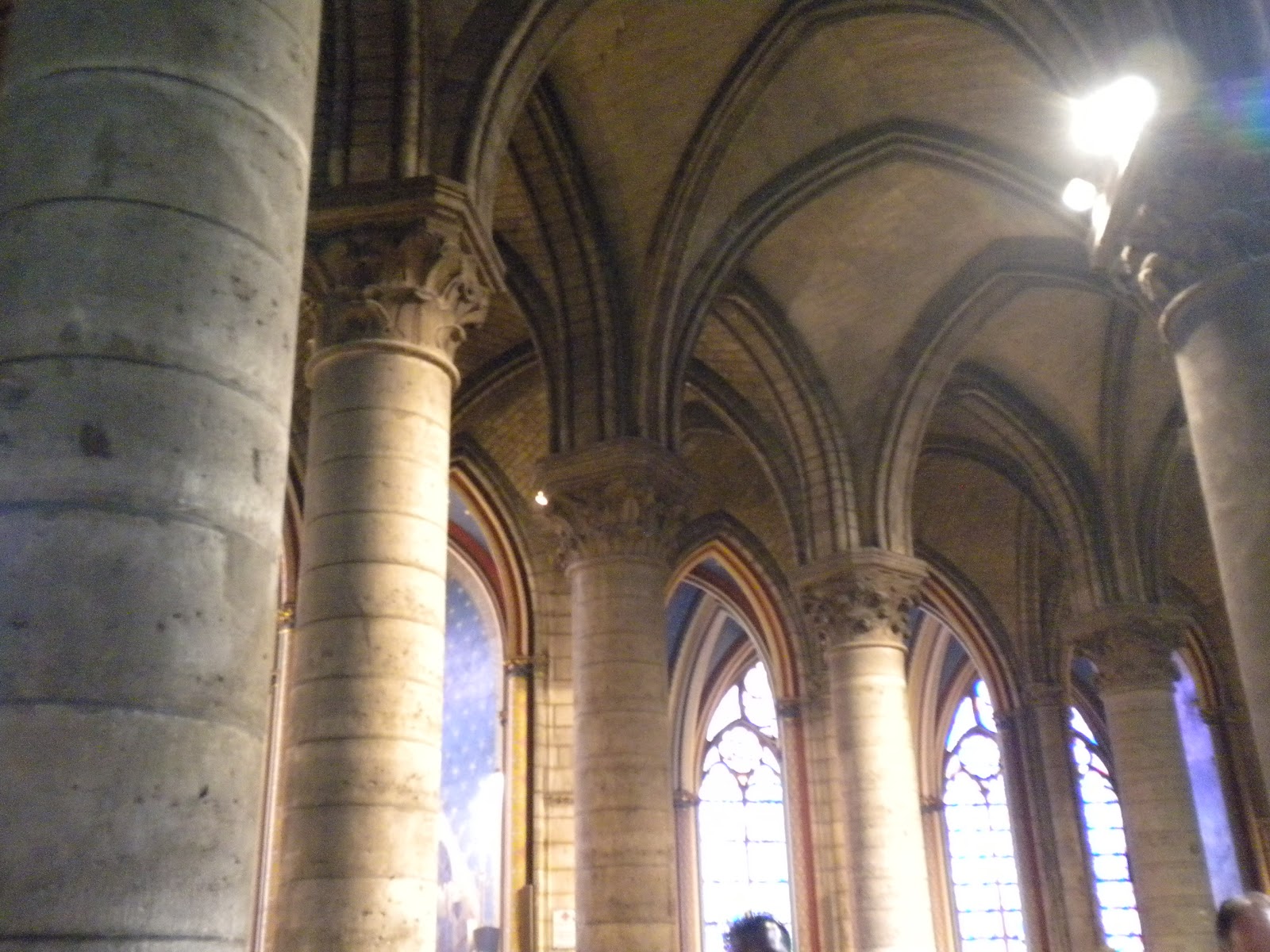
In any case, I was feeling the presence of the bell ringer inside the cathedral as well. The interior is as Gothic as you could hope for. I visited on a Sunday, so there was a special service going on, although that didn't stop visitors from flooding through the whole time. With all the prayers and rituals, it was a very eerie, unique atmosphere.


Priests lit fires for the ceremony, sending smoke up into the arches.




The Crown of Light, or Great Chandelier:

Just a few modern touches; including video screens for parishioners sitting further back...

Awesome.
P.S. I'll be talking about gargoyles and other stone monsters at the GANZA conference in New Zealand soon, if anyone has an interest in the topic, or Gothic things in general. Come see me get all tangential in person, eh.


