Tuesday, December 14, 2010

Twas Brillig

Nearly there now. Feeling positive about meeting Friday's deadline. Positive enough for a few pictures...

[James Gillray. The Republican Rattle Snake fascinating the Bedford Squirrel. Via]


[Creatures of Jabberwocky. Via]


[Richard Dighton. Absolute Wisdom or Queens Owl Taken from a Wood. Via]


[Decorative roman-like trophy, XVIIth century, "grotesque à l'antique", painted on a wall, detail, Château de Vaux-le-Vicomte, France. Via]


[Georgian-era (1824) Mermaid, a fake made up of various body parts from other animals. Via]

Yes, the blog is snowing. Yes, it is totally un-Australian. I like it. I like it so much I might leave it for the whole of next year.

Thursday, December 9, 2010

Undeadline


I have one week to go on my intro and I really, really want to finish it on time. Then revision of the chapters can happen. Then final draft can happen. Then submitting can happen. From now on, no overshooting is permitted!

As my incomparably wise supervisor has pointed out, I could keep writing the intro forever. At some point, you just have to stop. Keyboards down. Probably won't be posting much until I've hit this one.


I'm not entirely sure why Bill Bailey is on my wall. But his stare is oddly comforting. The man is a survivor.

Tuesday, December 7, 2010

Gautier, Darling


No, not that Gautier, sweetie.

More history. I'm talking about French wordsmith Théophile Gautier who, in 1833, agreed to write twelve articles for La France littéraire about certain under-appreciated poets of the time. These essays were to be collectively called Exhumations littéraire; making clear each writer's status as dead and buried in the public consciousness, and setting up Gautier's role as specialist excavator.

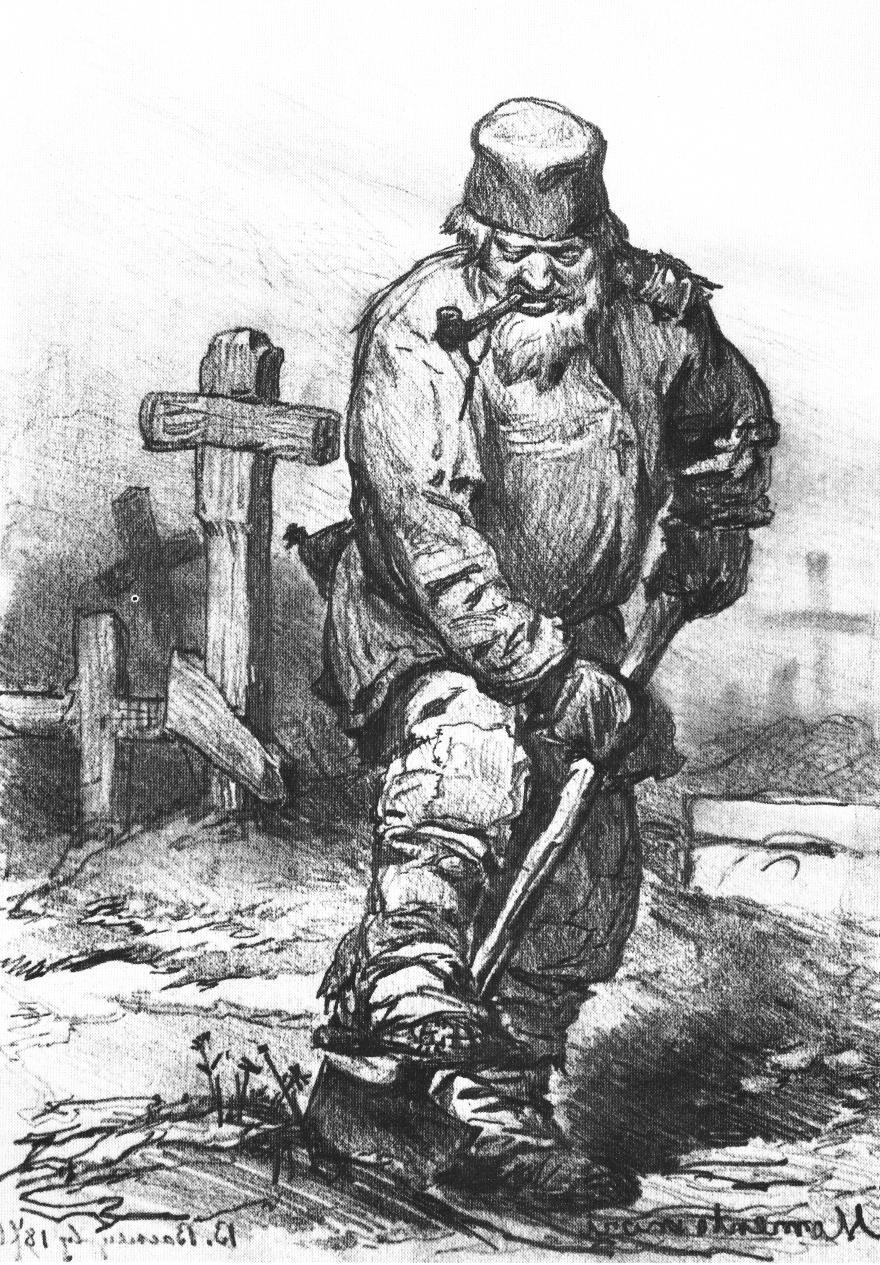
[Victor Vasnetsov. Grave-digger (1871) via ]

Editor Charles Malo must have been a patient sort, because the last essay of the batch was finally published eleven years after the contract was signed, hitting the presses in 1844. Significantly, for my purposes, these essays were then drawn together into a book titled The Grotesques.

My page numbers are from the English version of The Complete Works of Theophile Gautier volume II: "The Grotesques." This edition is translated and edited by Professor S. C. de Sumichrast, who provides the introduction and explains a few important facts.


The editor comments first on the use of "grotesque" in the title and its (in his opinion) dubious application to the poets treated within. (Already we have disagreement over which authors/texts can be called grotesque, seeming to indicate that different definitions of the term are in use.)

"It is a striking title, but it does not accurately describe the contents of the volume, or even the majority of the authors treated of by the critic; for no student of literature nowadays would dream of calling that great poet, Villon, a grotesque" (4).

He credits the appearance of the term with the recent popularity of Victor Hugo's "Preface," and quotes this text at length. I've already blogged about Hugo and the grotesque (in a double post: part1 and part 2) so I'm going to skim this and get right to the point.

"Gautier," Sumichrast explains, "fairly worshiped Hugo, and the "Preface" had very deeply impressed him, as more than one passage in "The Grotesques" abundantly proves" (6-7). This observation rings true, for Gautier puts forward a definition of the grotesque that is very similar to Hugo's.

Chapter one focuses on the poet François Villon, and Gautier's introductory remarks won me over right away. He explains his rationale for exhuming the down-trodden:

"The study of second-rate poets is both delightful and interesting, because, first, as they are less known and read, there are more novelties to be found in them; and next, because there is not a ready-made judgment for every striking passage. One has not to go into conventional ecstasies, to be convulsed, or to start with delight at certain places, as is indispensable with poets who have become classics" (15).

You had me at "conventional ecstasies," Monsieur Gautier.

For me this just captures that feeling I have sometimes when I'm reading a Very Important Book. The feeling that I must appreciate its many excellent qualities, but that there is a precise way of doing so that I'm probably ignorant of. It is not enough to simply read and enjoy the book - you must do it correctly!


[via]

Peer pressure, eh. Just when you think you've escaped it...

Gautier carries on:

"Among the second-rate poets one finds everything that the aristocrats of the Ark have disdained to make use of, - the grotesque, the fantastic, the trivial, the ignoble, the daring sally, the newly coined word, the popular proverb, the pompous metaphor; in a word, bad taste in its entirely, with its lucky hits, with its plated ware which might be gold, with its bits of glass which might be diamonds. Pearls are scarcely found elsewhere than in a dunghill, as witness Ennius" (16).

[James Gillray. An Excrescence-A Fungus,-Alias, A Toadstool upon a Dung hill (1791) via]


As well as Hugo, the mention of the word "ignoble" is a pretty obvious clue that John Ruskin's discussion of the grotesque provides inspiration here (I blogged him here: part 1 and part 2).

Most interesting to me is Gautier's understanding of "bad taste" and its potential value when taken seriously. "The grotesque, the fantastic, the trivial, the ignoble" are all grouped together under the banner of bad taste, and are all understood to have this deeper potential despite their maligned status. He is not merely excavating and resuscitating the poets, but these concepts as well.

Lest we find his passion for the distasteful unseemly, the author offers this clarification:

"I take singular pleasure in unearthing a fine line from the work of a despised poet... I rehabilitate him, I do him justice; and if at times my praise of some obscure poet appears exaggerated to certain of my readers, let them remember that I praise these writers in order to make up for all those who have insulted them beyond reason" (17).

These poets have been oppressed by the academy, "reputed poor, thanks to the judgment of a college pedant," and Gautier is having none of it (17).


[Théophile Gautier (1882) via]


Not all of the twelve essays were translated into English. In addition to Villon, this collection features essays on Théophile de Viau, Paul Scarron, Georges de Scudéry, Cyrano de Bergerac and Antoine Girard de Saint-Amant.

I can't talk about everything, but there are a few choice quotes worth mentioning. In particular, Gautier gets quite fiery in defense of de Viau. They share a special kinship, you know.

"Before I had read even a single line of his, I already felt a tender interest in him on account of his name, Théophile... I would willingly have thrashed that pedant Boileau for the harsh lines in which he insults my poor namesake."

"Forgive this foolish piece of pride, but it did not appear to me possible that a man bearing my name should be such a wretched poet" (62).

"It became necessary for the repose of my mind to confirm my entirely gratuitous supposition that Théophile de Viau was in fact as good a poet as I, Théophile Gautier" (63).

Tangent alert/ I hear Poirot's voice when I read this. Eg, "I, Hercule Poirot, world's greatest detective." Also, I understand completely. I've never read the books of Gwyneth Jones, but I feel certain that if I did they would be magnificent./


Gautier follows Victor Hugo's notions of the grotesque closely, specifically his assertion that the grotesque is "the richest source that nature can offer art." Nature is not all beauty, but equal portions of the ugly and the beautiful, and both must be represented and valued. Gautier's "bad taste" definition of the grotesque fits this bill.

"Good taste is a fine thing, but it must not be carried too far. Through excess of good taste very many subjects, details, images, and expressions which have all the flavour of life are lost" (267).

Gautier's philosophy and determination to dedicate time and energy to "bad taste" texts scorned by other critics reminds me of how popular culture was often framed during the 20th century. It also makes me think of how texts such as comics and video games continue to be looked down upon by some within academia. It is not so bad now, of course, as it once was. Perhaps if all pop culture theorists had the conviction of Gautier we would have come further, faster.

Please note: I do not recommend "thrashing" people who don't like your area of study. Not really. Maybe a little.

Dead Classics


I probably shouldn't be thinking about zombies right now, but check out these brilliant posters by Matt Busch.

"As opposed to just taking the original posters and altering them digitally in PhotoShop, Busch has painstakingly hand-painted every detail with traditional mixed media, before slaughtering them with a zombified treatment."

“It’s an ironic twist,” says Busch, “to take these beautiful master-works and attempt to recreate every detail, while at the same time, shredding them to bloody pulps. Literally. Nothing here is sacred, but it’s all in good fun and out of the utmost respect to the original posters that had such an impact on my life.”


My favourite:


Find a whole lot more "Hollywood is Dead" posters here.

[Via]

Friday, December 3, 2010

Splice Me Up, Before You Go Go


I've mentioned my love of BioShock once or twice on this blog before. Here is the trailer, if you don't know what I'm talking about.

One of my favourite parts of the game is the Splicers; citizens of Rapture (a dilapidated 1940s underwater city) who have abused gene altering substances to the point of physical mutation and mental instability. Splicers are always ranting and singing to themselves.


And sometimes they just whistle.


There are a bunch of action figures out for BioShock and BioShock 2. I decided I should get the latest. Specifically, the Lady Smith Splicer. For research purposes, you understand... *ahem* I was curious to see how her figure would look in the flesh, so to speak, considering her outrageous persona and physique in the game. She's not your typical bodacious female figure.

The Lady Smith is one of the most snobbish enemies, as she was originally an upper-crust lady of leisure:

"Once she was the talk of the town – a high-profile socialite whose wit was her weapon among Rapture’s elite. As the city fell from grace, so did she – becoming addicted to ADAM, splicing herself stronger and faster to feel safe in the streets. She resents having to eat refuse and scrabble for ADAM, but ultimately, she’s a survivor. As a "Leadhead", she pelts her enemies with bursts of tommy-gun fire between vicious verbal barbs."


[Via]

Speaking of verbal barbs... these are a few of her choice sayings from the first game:


Snarky. Anyway, she arrived yesterday, and is so lovely and horrid I thought it was worth sharing a few pics.


She comes with masquerade mask, a gun and a rolling pin.


Her quality is a lot better than I expected. The skin is particularly good, bulging with veins and chords. Check out these details:


The huge fleshy growth on her waist is matched by a lump on her arm which has split her long glove.


I like how she is bursting through her 50s style dress at the back. It reminds me of The Hulk and how he erupts from his clothing.


The rolling pin, perm and pearls offer a nice touch of 'femininity gone wrong.'


Don't look now, but I'm 90% sure she has a breast growing on her leg.


Cute shoe. She has also grown a tail from one leg, while the other foot has come to resemble more of a hoof/claw.


It seems to me there is something quite poignant about the idea a woman would mutate her body so dramatically: "splicing herself stronger and faster to feel safe in the streets." Women today are surgically altering their bodies for beautification purposes. But would they do it for physical power? What kind of environment would justify such an act? And at what cost?

(BioShock engages with plastic surgery also, through the character of Dr Steinman and his "Aesthetic Ideals" clinic. You can check out his bit of the game here- warning, major spoilers.)


As one reviewer put it: "NECA's Ladysmith Splicer is a hideous monster of a woman. She's painful to look at, and unsettling to consider. But that is as it should be: that's how she looks in the game, as well. "

If I still had my childhood barbies, they would definitely be clutching their pink purses tighter tonight.

Tuesday, November 30, 2010

Grotesque Investigations

It seems everyone has an opinion on the grotesque. Everyone has performed their own investigation and constructed their own definition of what 'it' means. Even Sherlock Holmes himself.


[Via]


Arthur Conan Doyle, via Holmes, clearly has his own notions about grotesqueness, as this excerpt from The Adventure of Wisteria Lodge reveals:

I find it recorded in my notebook that it was a bleak and windy day towards the end of March in the year 1892. Holmes had received a telegram while we sat at our lunch, and he had scribbled a reply. He made no remark, but the matter remained in his thoughts, for he stood in front of the fire afterwards with a thoughtful face, smoking his pipe, and casting an occasional glance at the message. Suddenly he turned upon me with a mischievous twinkle in his eyes.
"I suppose, Watson, we must look upon you as a man of letters," said he. "How do you define the word 'grotesque'?"
"Strange--remarkable," I suggested.
He shook his head at my definition.
"There is surely something more than that," said he; "some underlying suggestion of the tragic and the terrible. If you cast your mind back to some of those narratives with which you have afflicted a long-suffering public, you will recognize how often the grotesque has deepened into the criminal. Think of that little affair of the red-headed men. That was grotesque enough in the outset, and yet it ended in a desperate attempt at robbery. Or, again, there was that most grotesque affair of the five orange pips, which let straight to a murderous conspiracy. The word puts me on the alert."
"Have you it there?" I asked.
He read the telegram aloud.
"Have just had most incredible and grotesque experience. May I consult you?
"Scott Eccles," "Post Office, Charing Cross."
"Man or woman?" I asked.
"Oh, man, of course. No woman would ever send a reply-paid telegram. She would have come."


[Via]


Mr Eccles arrives, most disturbed, in a state of dishevelment.

"I have had a most singular and unpleasant experience, Mr. Holmes," said he. "Never in my life have I been placed in such a situation. It is most improper--most outrageous. I must insist upon some explanation." He swelled and puffed in his anger.

Before he has a chance to explain, the police arrive. They suspect him of murder.


[Via]

You will have to read the rest of the story here to find out what happens. It is quite spooky.

[Via]

This example has been cited quite a few times, usually in the introductions to books on the grotesque, and particularly in those sections dedicated to exploring the myriad ways of defining grotesqueness. Holmes' definition fits with more sinister ideas about the grotesque, those involving "the tragic and the terrible." It is "something more" than strange.

I must confess that Hercule Poirot is by far my favourite detective, but Holmes earns my love for his comment that "the word [grotesque] puts me on the alert." We have that in common.

Criminal and academic investigations are not entirely different...

One must be wary of getting too carried away with incidental details. Although, these are sometimes crucial.


You should try not to over-complicate matters and confuse yourself. These things can spiral, you know.

And avoid assumptions. Their success depends upon everything going your way, which will rarely (never) happen.


I'm doing the evil voice right now.

Friday, November 26, 2010

Eye See

Have you heard of the Freaking News website? Me neither. Until I found these images in a random search for 'grotesque' pics.


That's right, celebrities with eyes in their mouths. Genius!

Freaking News is apparently a site that hosts Photoshop competitions, or something of that nature. Being the internet, it could all be some elaborate scheme to make us inadvertently purchase beauty products or catch a computer virus.

But anything that puts eyes in mouths can't be that bad. Right? In any case, the whole site is a bonanza of body morphing.

Calls for pictures are sent out on a particular theme, such as 'One-Legged Celebrities.'


Or 'Celebrities Upside Down.'


If you can put an eye in a mouth, why not a mouth in an eye?


More here. Warning: some things cannot be unseen.